H2OME has moved!

You will be automatically redirected to the new address. If that does not occur, visit
http://www.h2o-me.com
and update your bookmarks. Thanks! - Brook

Tuesday, March 18, 2014

Question of the Week

This is a good opportunity to do some simple math that can help you understand how useful a greywater system can be for you and how changing your landscaping can help much more substantially!

My last water bill used 46 HCF for 61 days.  If we could skim at least 22 HCF off per cycle, that would keep me in the bottom two price ranges (tiers).

…We do about 10 HE laundry loads per week.  Would just setting up grey water from the washer be enough to cover those 22 HCF

The answer to this is twofold.  First of all, a high efficiency washing machine uses about 10 gallons per load these days.  So 10 loads would equal 100 gallons per week.  That adds up to 400 gallons per month.  You could be watering 3-4 mature fruit trees with that water!

On the other hand, 1 HCF (hundred cubic feet) is 748 gallons.  So you would only chip into your water use by just over 1/2 HCF a month which isn't really going to make a dent in your water bill!

Now, if you consider lawn (the biggest water user in our landscape), which can't really be watered with this greywater without substantial investment in pumps, filters, and specialized irrigation ($5K +), you'll find that 500 square feet of lawn uses 13,000 gallons of water a year.  That's over 1K gallons a month, which is about 1.5HCF.

So getting rid of just this much of your lawn (which is free if you sheet mulch it) will save you 3 times the amount of water the above greywater system ($600-$800) will save you.

The key point here is to start with a good landscape design.  Know what you absolutely want in your yard.  And put the elements in efficient relationship to each other and to water sources.  Things that are going to be using shower greywater will rely on gravity and need to be placed downhill from the shower.  Things that are going to be using laundry greywater can be higher because of the pump on the washing machine.  And make sure there's places that can catch water falling off the roof in a rainfall and allow it to absorb in!  That's free water!

There's so much more to it than this.  This is why consulting with an expert can save you a lot of money and time in the end.  Before you implement an expensive system, reducing your consumption and efficient placement will get you off to a better start!

For more information, call or email me for a consultation or contact my friends Kevin and Christopher from Savanna Agriculture to get a design for your space with edible and water efficient landscaping.

Wednesday, February 19, 2014

Upcoming Events

MARCH
15 - Water Harvesting Open House

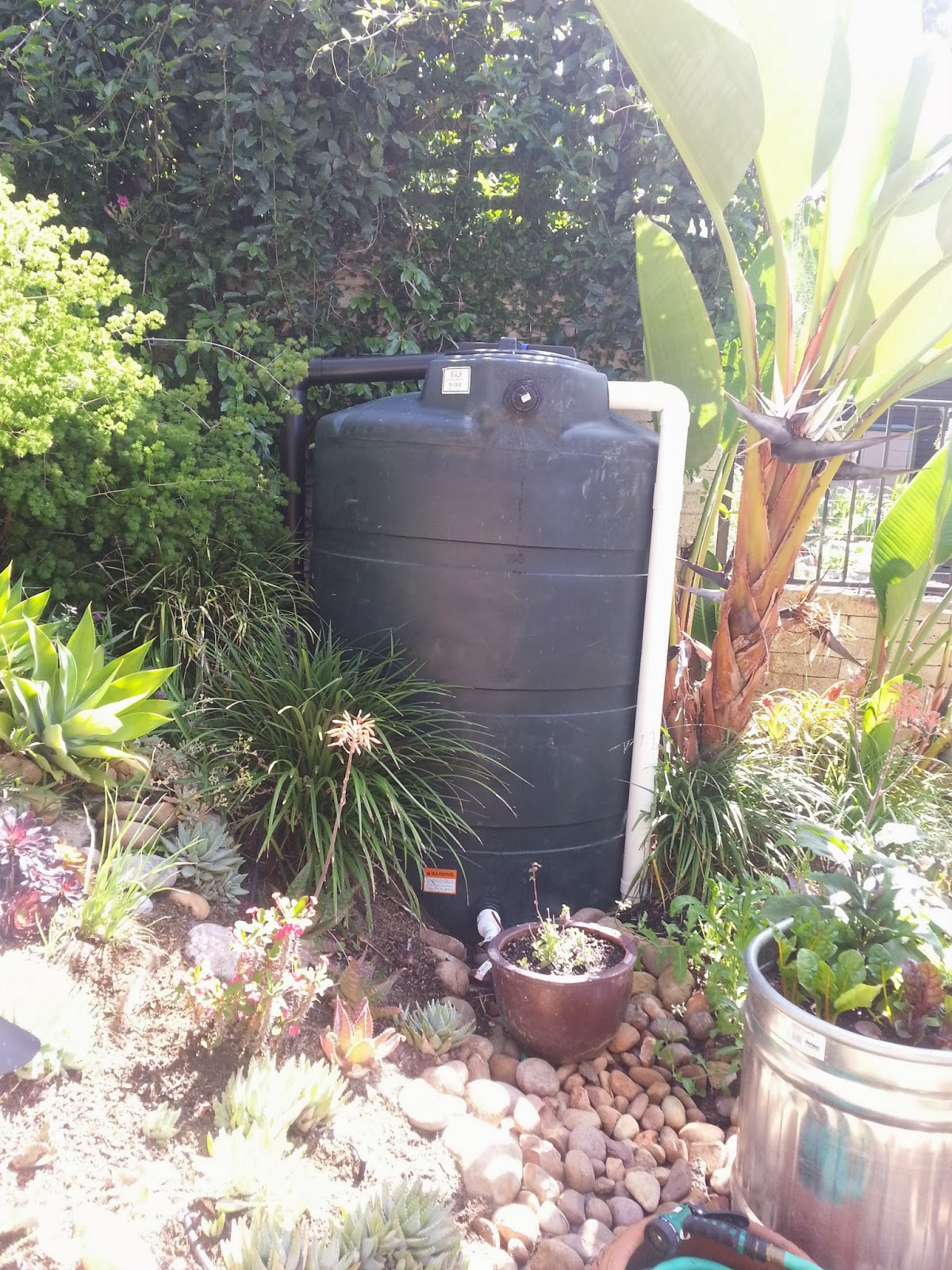
This is your opportunity to get up close and personal with very simple and productive water harvesting features such as rainwater tanks and greywater systems. We'll take you on a tour and explain the many aspects of rainwater tanks, Laundry-to-Landscape Systems, and a shower greywater system including materials, costs, do's and don'ts, rebates, and permitting.

22 - Master Gardeners Spring Seminar

This is the Annual Master Gardeners Spring Seminar. It's a great opportunity to take a wide range of class offerings covering all things plant and garden. I'll be discussing rainwater harvesting from 10:30 - 12 and look forward to seeing you there!


29 - Greywater Installation Workshop

This hands-on workshop will teach and inspire participants to install their own “Laundry to Landscape” greywater system. Learn how easy it is to use the washing machine to irrigate fruit trees and more with this cheap, easy, and permit-free legal method of greywater reuse. By the end of the day, participants will be able to design and install their own laundry to landscape greywater system with confidence. Cut down your water bill and grow an ecological and food producing garden. This class includes many handouts related to greywater design to help you further setup up your own system.

Saturday, February 8, 2014

Food Water Connection

Most of you know that I do consultations as well as installation.  One of the best parts of my job is connecting people to resources.  I certainly don't claim to be able to do everything.  But I know some amazing people and resources in our community that I'd like you to know about too. 

We all know water is precious.  The other basis for human sustenance is food.  We all know it takes water to grow food, but what we may not realize is that food grown outside of our community takes far more water than food grown here locally.  The additional water costs are related to transportation/petroleum energy as well as crops grown in places they shouldn't be (like lettuce in the Imperial Valley) but due to water allocations and special pricing for agriculture, it can be justified for the price points you see at the store.  

If you really want to conserve water, besides planting yards that use only onsite water, if you can harvest additional water supplies (like rain from your roof in tanks, or greywater from your showers and laundry) you should grow food.  Then these technologies which are generally expensive and have 5+ years ROI minimum become more viable because you are generating additional cost savings, by decreasing your spending at the grocery store. 

Now to the resources:
1.  You want to redesign your space to grow food.  About half the time I go out to a consultation, what you want to do is grow food.  Logically you want to "plant the water" first.  But aren't sure what you want to grow with it.  This is a great time to call Kevin and Christopher with Savannah Agriculture.  They can develop a plan for growing a combination of drought tolerant, local, native, and edible plantings according to all your water resources.  Kevin Muno <kevin@savannaag.com>

2.  You want to grow veggies in your yard.  You'd rather not start slow and spend time and energy trying a bunch of techniques that might not work.  You might not have time and energy to do a great job but you have the space.  You should connect with Mia from Good Neighbor Gardens.  She has a backyard CSA program that provides ongoing maintenance and harvests from your yard combining your abundance with other yards in the community to create a wonderful biweekly box of veggies/fruits/ and other yummies.  AMAZING!  Why hasn't anyone thought of this before?!   

3.  You want to learn everything you can about growing your own food and holistic design.  Have you heard about the San Diego Sustainable Living Institute?  Have you heard about Permaculture?   I can guarantee after this class, you will see the world through different eyes.  You will have tools and resources you need, as well as having made connections with other like-minded people here in San Diego to be able to work towards designing your space and maybe creating a career combining forces with others to create change in our community.  

4.  You want to meet these people and be inspired by a functional local non-profit farm!  Check out the Kale Festival coming up Saturday, February 22 at the San Diego Peace Garden in City Heights.  And if you love the Peace Garden you can come help out and learn all about growing food on Wednesday mornings!

5.  You want another chance to meet these people, AND see water harvesting in action in the form of 2 x 500 gallon tanks, shower greywater, and laundry greywater in a highly productive and beautiful garden.  On March 15th, we will open a charming yard in South Park where you will be able to meet all the people above as well as see these water harvesting features.  We will have someone from the Water Conservation Department on hand to discuss the current rebate programs.  And I will give a tour demonstrating all the features and describing all the costs associated with the different water harvesting elements.   You can find more information at http://www.h2o-me.com  and RSVP at www.sdsustainable.org

6.  If you want to learn to install a greywater system yourself, check out our upcoming Greywater workshop on March 29.  http://sdsustainable.org/event/laundry-to-landscape-greywater/

7.  Here's some other local edible landscapers you might want to check out:
and a drought tolerant/native landscaper


Keep on Growing!
Brook Sarson
H2OME
Smart Water Savings
619.964.4838


Tuesday, January 21, 2014

Where is the Rain?


I know I'm not the only one who has finally gotten to the point where this beautiful San Diego weather is actually feeling quite ominous.  The politicians are using the word "drought" to secure funding for water projects of all shapes and sizes.  You can read the various articles linked in this paragraph to see several different takes on what the drought means to us at home and at the state level.  Meanwhile, I argue that we all have a responsibility to our community to ensure adequate local water resources.  Don't wait for politicians and agencies to satisfy your water needs.  Please, please do reduce your water consumption.  Also consider storing water onsite in the guise as rainwater.  Also consider watering your thirsty plants with your gently used shower or laundry water in the guise of greywater!

Consider this:  There are over 290,000 single family homes in San Diego City alone.  If each of those homes put in 500 gallons of rainwater storage (4' diameter tank, $400 rebate from the city, $75 rebate from the county), we would have almost 15,000,000 gallons of local water onhand.   Relative to total water use this is just a drop in the bucket, but considering the multilayered cost of 15,000,000 gallons from our existing sources (environmental, economic, sustainable, disaster proof) this is a significant step we can all take to be part of the solution.

Here is a link for City Rain Barrel Rebates

Here is a link for County Rain Barrel Rebates

Also consider that a typical 4 person household with a newer, efficient washing machine, washing 4 loads a week produces 40 gallons a week, which equates to over 2000 gallons for the year.  Do you do more or less than this?  Is your washing machine old?  If so, you may be producing 50 gallons per load!   To put in a greywater system to water your trees, shrubs, and vines with this water can cost as little as $250 (DIY)  and usually not more than $750 (installed).   Wow!  2000 gallons for every washing machine in San Diego to ensure that we have trees and shrubs and vines that can feed us or at least reduce the scorching heat island effect by softening the sun's reflective potential.  It's worth it San Diego.  

What's really cool is that the Sweetwater Authority is giving $75 rebates for greywater systems in their region!! 

When can we have that from San Diego City?  And all the other parts of the County?

And that's certainly not all you can do.  Check out the following events and classes to learn more about reducing water consumption and living within our water budget.  Do it for yourself, and for your community!

  • This Saturday, January 25 at the Museum of Natural History in Balboa Park from 10-2, join me and a ton of other water related experts while we showcase strategies, technologies, and complexities related to water in Southern California
  • Take a Permaculture Class with the San Diego Sustainable Living Institute in May.  Learn more about creating a holistic design for your home, garden, community including choosing water strategies and plant pallets that are appropriate for our spaces. 
  • While you are at it, check out the Great Greywater Challenge.  Donate, offer your home as a workshop site, put your greywater system on the map.
  • For those of you further north, check out the Ecology Center in San Juan Capistrano!  It's an amazing education resource for sustainability.  With a number of classes including water harvesting, natural food prep, and backyard gardening, to it's Eco-Apprenticeship Program, and it's onsite store it's a wealth of information and resources.


Tuesday, November 27, 2012

Perspective: Rainwater vs Greywater in San Diego


Prepare yourself for some wild numbers!

Check this out San Diego!  You want to see a crazy cost comparison?  Assume that you have a 2000 square foot house.   Not crazy big for SD.  At 600 gallons/1000 square foot/inch of rain, this looks like 12000 gallons of rainwater coming off your roof for the year.  Assume you wanted to store most of it, and you have room for 9000 gallons of storage on your property (above ground, round plastic tanks are cheapest).  You may want all the water to keep your 500 square foot lawn green (which wouldn't quite be enough anyway) or maybe you have a thriving food forest which is providing you with high quality organic food (that sounds delicious!)

If you add up all the $$ it's going to cost to install 9000 plus gallons of rainwater storage, it will be in excess of $10,000. If you want to tie it into a pump and feed it into the irrigation system that will add another $2000 or so.
That comes out to over $1/gallon.  

Now let's look at shower greywater for a four person household:

Mom showers 15 minutes a day (are they using low flow showerheads (2gallons/minute)?) = 30 gallons/day
Dad showers 5 minutes a day = 10 gallons/day
2 kids at 20 minutes a day  = 80 gallons/day
____________________
Total = 120 gallons/day x 365 gallons for the year = 44,000 gallons +/- for the year

If you are installing a permitted system for 2 showers to gravity flow into mulch basins on your property, this could add up to maybe $5K, on the high side.  Note, you don't want to use this on your lawn!

That comes out to $0.11/gallon

Now if you want to compare that with water coming out of your tap.  If you look at your water bill, you are charged per HCF (1 Hundred Cubic Feet = 748).  Depending on which tier you are in and what city you live in  this could be about $3-6/1HCF which adds up to about to between $0.0004 and $0.0008 per gallon.

Water is cheap San Diego.  But everything comes at a cost!  There's tons of literature about the cost of bringing water to San Diego from hundreds of miles away from the Colorado River and from the Delta up in Northern California.  Make an informed decision.

Friday, October 26, 2012

Greywater: A Simple and Effective Resource for Water Starved San Diego


Greywater is water that comes from showers, sinks, and laundry before it combines with toilet water.  Kitchen sink water is blackwater in California.  Many people are nervous about using greywater for fear of contamination and the ick-factor.  Greywater use is not only common but legal and encouraged by public utilities all over Arizona, New Mexico, Australia, and many other parts of the world.  There are over a million users in California alone, and no instance of anyone getting sick from greywater use.

A UCLA report, titled "Graywater: A Potential Source of Water," estimated that if 10% of Southern Californians implemented graywater systems for their laundry, showers, dishwashers and faucets, "the potable water savings would be equivalent to, or larger than, the capacity of a modern, large seawater desalination plant such as those proposed for California."  That’s exciting news for taxpayers!

Last year, San Diego experienced a massive power outage.  Millions of gallons of sewage spilled into the Los Penasquitos Lagoon and the Sweetwater River due to lack of backup power at the sewage treatment plant.  It is clearer than ever that homescale greywater use has its place in our communities.  If each residence around San Diego, and beyond, had laundry and shower greywater systems in place, we could reduced the amount of water being sent from each home to the sewage treatment plant by half. This is a small investment in infrastructure compared to the grand scale of municipal water treatment.

The landscape is designed to capture and treat this slightly used water in the soil, with mulch basins and plants providing high levels of microbial activity which bioremediate any solids or pathogens in the water. This compared to high volumes of water with added solids and pathogens from toilets spilling out directly into our waterways?

Greywater regulations changed in California in 2009 to allow simple Laundry-to-Landscape systems with no permit required, and simple shower systems with specific requirements and a permit.  A simple Laundry greywater system can cost as little as $150 in parts if you do it yourself or as little as $500 if you have a professional install it.  With the potential for producing a couple thousands of gallons of nutrient rich reused water, this is a great investment!  Shower systems can be more complex, especially if you are on a slab, or your bathroom is upstairs.  You may have to hire a plumber well versed in greywater to install your 3-way valve and a landscaper well versed in water conservation, or a water harvesting professional.  The simplest shower greywater systems may cost as little as $600-$800 depending on a multitude of factors including if you have a crawlspace, what kind of slope you have in your yard, how much water is being managed.
A basin designed to collect the water from the
Laundry Machine at the drip line of the tree.
This basin will be filled with mulch.

Many people think of storing greywater and using it in existing irrigation systems, but this is a far more expensive and complex setup than most people need, involving pumps and filters.  A gravity fed system is efficient and cost effective.

Most anyone can implement a Laundry greywater system if their laundry room is on an outside wall, or in an outside building.  By adding a three-way diverter valve to your washing machine hose, you can control whether to send your laundry water out to your yard or down to the sewer.  This is important for instances where you may use bleach or have some other toxic chemicals in your laundry or it has been raining substantially and your yard is saturated, for example.

By keeping the water in a 1” line, you keep pressure from your washing machine pump, allowing you to take the water slightly uphill or over longer sections of garden, and do not constrict the pump flow causing burn out.  From here, you can simply pop a hole in your outside wall and bury your line out to your trees or shrubs.  You can put in as many branches as you need, adding ball valves to control the flow to specific locations. 

It is important to calculate your water budget, which is affected by what kind of machine you have (10-50 gallons) and how many loads a week you do.  Then you can take into account what landscaping you are watering and how much water it will need in an average week.  This way you do not spread the water too thin, or overwater your plants. 

It is also important to use your water on plants that will respond favorably to this slightly more alkaline and saline water supply.  Typically lawn is not ideal since there are potential pathogens in this water and, when a lawn is used for recreation for pets or people, they may come into contact with these pathogens.  You should not water root or leafy green vegetables with this water for the same reason.  Fruit or other trees as well as shrubs are ideal.  Some natives are sensitive to salty soils and may not appreciate this water.  If you are not sure, ask at your local nursery, or contact a water harvesting professional.

Which soap you use matters.  Check out the ingredients and avoid anything with sodium in any form.  Usually powders have a sodium base.  Avoid borax as well.  Two sure bets are ECOS, available at Sprouts and Costco and Oasis, available at Peoples Co-op or online.

There are now more resources in San Diego than ever to create efficient and effective greywater systems.  Look for water harvesting workshops and tours especially with the San Diego Sustainable Living Institute, water harvesting professionals, articles and blogs.  The Olive Branch Green Building Supply has started stocking greywater materials and offering educational resources for greywater. 

Wednesday, September 19, 2012

Justifying Rainwater Collection: Calculating the True Cost of Cheap Water


The other day I got a question that I get all the time.  It is a good time to answer this question in a public forum, especially considering the rainy season is almost upon us.  We can all benefit from changing the way we think about our water resources.

Q:  In running the numbers for rain barrels, filling a 1500 gal barrel twice equals 3000 gal or 4 HCF. That's just under $15 (this is at tier 1 costs). which makes the payback for a $1500. system equal to 100 years. 

These numbers are hiding a lot of costs that we are not thinking of as we turn on our tap and let the water flow out at pennies per gallon.  What if we start to factor in some of these hidden costs?  What would our cost/benefit analysis look like?

First of all let's readjust our expectations of the costs involved in setting up a 1500 gallon tank.  You can get a 1500 gallon rainwater tank from The Tank Source, located in Alpine for about $600, plus about $100 for shipping.  This tank has about an 8' diameter, which is certainly doable for some but not all residents.  I think a 1000 gallon tank with a 6' diameter is a little more realistic for most urban homes here in SD, at a cost of about $600 plus $100 for shipping.  You can see that it is more cost effective to get the largest tank you can.  If you want to set this tank up yourself, you would need a couple filters at a cost of about $80.  You will need some pipes and parts, totaling between $100-250 depending on the distance you are taking the water from your house and a few other nuts and bolts.  This can look like as little as $800!  Or if you have a professional install this tank, you may expect to pay about $400-$500 in labor costs.  Now we are getting up to $1200-$1300.  But did you know that the City of San Diego is offering up to $200 in rebates for rainwater tanks?

Some of you may be wondering if it is even possible to get 1500 gallons of water off your roof in our arid climate.  The answer is ABSOLUTELY!  Check out this amazing rule of thumb and compare it to your situation:  A 1000 square foot roof will yield 600 gallons of water in only 1" of rain.  It rains about 10" here in San Diego.  So you can fill this tank up in less than a third of our rainy season, which means you may be able to fill it up THREE times even, if you can find something to use the water on in between rains.

Those are the basic nuts and bolts of this example system, but let's delve further into the cost of water. Consider that water in Southern California is excessively underpriced for its actual cost with regards to energy, environmental, and legal impact.  You can decide for yourself whether or not you think this is a true statement after we consider some additional information.  You could start by reading Cadillac Desert, by Marc Reisner to help you understand the intricacies of how and why our water infrastructure was built.  As we become confronted with the reality of the related costs associated with cheap water, prices will raise significantly, and any conservation tactics we have put in place before that time will greatly reduce our dollar cost in the future.

Did you know only 20% of our water comes from local sources?  The remaining 80% comes from both the Delta region up in the Bay Area and the Colorado River.  This means a few things.  First of all a drought that may be affecting other regions, and not us directly will certainly impact our water supply.  Also, there are legal battles ensuing over Colorado River water and Delta region water than may reduce the amount of water coming to Southern California.  Let's imagine you have a valuable investment like an established fruit tree, or many.  If there are drought restrictions in place that limit how much you can water your garden (kind of like last summer), wouldn't that water in your 1500 gallon tank become more valuable to you as asset protection?

Did you know that 20% of California's energy costs are associated with moving water around the state, including the incredible feat of pumping our water supply from the State Water Project 1,926 ft over the Tehachapi Pass north of LA.  So let's add some energy costs into the cost of getting our water out of the tap.  Let's also factor in the benefit of having an emergency water supply on hand if power is disrupted for any reason for any length of time.  Maybe that water supply is for protecting your established food production, or maybe it is even more valuable as a drinking supply.  Can you calculate what bottled water will cost per gallon in an emergency and compare that to the cost per gallon of the water you have stored in your tank?

We have only been addressing water supply issues, but what about the value of mitigating storm drain runoff?  How many of your tax dollars are allocated toward dealing with storm drain pollution, or even urban flooding associated with the massive volume of runoff created by paving over as much as 80% of our permeable surfaces in urban areas?  If all of us put at least some of our rainwater from our roof into rainwater tanks, and then redirected the remainder of our runoff into our gardens, which were landscaped to hold water using basins, mulch, and appropriate plantings imagine how much money could be saved at many levels.  Think of tax dollars and grant funding being used to clean up waterways that get inundated with polluted storm water.  Think of tax dollars being used to repair and clean storm drains every season!  Think of redirecting this money to funding education in schools and communities and rebates for systems that serve the double purpose of augmenting a limited local water supply!

Now if you are going to use this very expensive water source to keep your lawn green, you might not consider a rainwater tank cost effective, especially if we look at some very simple figures.  Lawns typically require about 50" of water to stay green throughout the year.  It rains about 10" here in SD.  If you run the calculations of applying 40" of water to 500 square feet of lawn, you realize 13,000 gallons of precious water are required to keep that lawn green.  It is hardly worth storing 1500 gallons, or even 3000 gallons to maintain this aesthetic.  Why not get rid of the lawn and plant something that can be maintained with that 3000 gallons, like natives, or Mediterranean plants such as the Nifty 50.  Native plants maintain a diminishing local ecology which is being threatened by paving and invasive plants.

There is great value to using our precious water resources to grow food locally.  There is an even greater water footprint than what we see on our water bill every month, associated with goods and services we buy and support.  Be on the lookout in the Union Tribune for an article about this in a couple of weeks.  Try to imagine that an orange brought in from Florida has a higher fossil fuel cost, which has an associated water cost, than something grown here in California.  Furthermore, an orange grown in an industrial agriculture setting will have a higher associated water cost than one grown in your backyard.  Furthermore an orange grown on rainwater in your backyard will have the lowest water footprint of all!
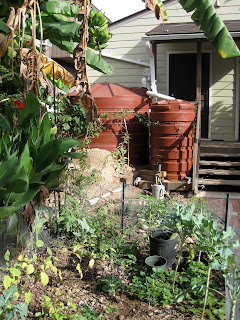
This is a lot to take in when you are justifying the purchase of a rainwater tank.  Food for thought: why not consider using greywater!  A simple Laundry-to-Landscape system which sends your laundry water (non-toxic, organic, sodium-free soap included) to your trees and shrubs can cost as little as $150 in parts, or $500 installed by a professional.  If you run 4 loads a week on an older front load washer at a rate of 35 gallons per load, you'll be making over 7000 gallons of water available to your landscape over the course of a year.  If you combine this with trees and shrubs that are actually producing food for you that you don't have to buy from the store, and you take into account the additional nutrient content of this water as a fertilizer that you don't have to purchase and will increase production of your plants, you can see some pretty astounding justification for this water conservation strategy!

For more information about these simple strategies and specifically what is possible in your own space, check out the upcoming Water Harvesting Tour this Saturday (http://www.facebook.com/events/408710185858142/)


or contact Brook Sarson with H2OME at brook@h2o-me.com to schedule a consultation!

Thursday, January 19, 2012

Upcoming Events


Make Your Own Rain Barrel Workshop

Saturday, February 18, 2012. 10:00am-12:30pm

Location: City College

Are you ready for the rain? If you’ve been looking for a cost effective way of saving rainwater, we are offering a solution. Come and make your own rain barrel to take home!

We will provide clean, recycled, food grade 55 gallon plastic drums along with a kit of parts to tap it for a hose fitting on the bottom and an overflow on the top, as well as mosquito-proofing options. You will be able to drill your holes and assemble your barrel onsite.

The class will begin with an educational seminar covering various facets of water harvesting from understanding what your rainwater potential is, how to use your rainwater, how to accommodate runoff in your landscape, as well as greywater use and regulations.

The cost of the class is $75, If you would like to participate in the workshop but do not want to take home your own barrel, the cost is $25, sliding scale. If you would like to purchase an extra barrel and parts, the cost will be $50. Cash or check will be accepted. Don't forget that you can apply for you barrel rebate of $27! $5 of your fee will go to Seeds, the Urban Farm at City College to further the programs they offer.

This will be a great opportunity to connect with community members and learn more about using our water resources.

Please RSVP by Monday, February 11 to ensure your spot. Spaces are limited to the first 15 people to sign up. You can RSVP to brook@h2o-me.com or call 619.964.4838


Monday, November 21, 2011

Observation Shows Us What Nature Intends


The rainy season is a good time for us to begin to observe what works and what doesn't work. Your observations can begin up at the top of your watershed in the mountains nearby, or down at the estuaries leading into the oceans, or even in your own neighborhood and yard. When it rains, watch the rain pouring off your roof to see where it flows. Watch the water coming out of your downspout: where is this resource being directed. Watch the water moving off your driveway, walkways, soil: where is water flowing, pooling. We can learn so much about what small steps we can use to harness natural energies.

I noticed this, this morning after a day of rain yesterday and got so excited about the teaching opportunity exhibited. Here the street is eroding so there are areas where sediment gets deposited when the water flows. Soon enough, weeds have populated this area and grown enough to impede the flow of water just enough to catch debris during the water's journey down the storm drain and out to our river and ocean. A "healthy" collection of cigarette butts, plastic, leaves, seeds, sediment, and things we can't see see trapped by this debris like oil, copper from car brakes, bacteria from animal poop populate the area upstream of this weed. Additionally, more seeds have been able to germinate in the building sediment and nutrients accumulating (can you spot the milkweed growing?). This is what happens in nature!! Far upstream starting in the mountains, where the water flows are occurring naturally, plants filter all kinds of contaminants out of the water flow as well as slowing the water flow so it can have a chance to soak into the ground along the way to hydrate the soil and plant life in these areas. What happens when we raze a hillside and pave it with rooftops, driveways, and storm drains with no opportunities for this natural filtration? We get huge volumes of water flowing at difficult to manage velocities, with massive amount of pollutants, headed straight for our waterways which are ill-equipped to naturally handle the influx of volume and bacteria. Thus our beaches are shut down, our aquatic flora and fauna are threatened, and flooding creates more need for $$ to build infrastructure to handle all of it!

Small changes like this are the first step to helping us rebuild what we have destroyed. If only we can use our observation skills in combination with our problem solving skills in combination with our compassion for each other as well as even the smallest living thing, we may have a chance at building something at least not degenerative... maybe we can even strive beyond sustainability to regenerative design (leaving something better, more productive than how you found it).

Friday, September 9, 2011

Water Security Now.

Sitting in a candlelit room talking about the effects and concerns of the recent power outage with friends, our immediate thoughts were for basic needs. With threats of the outage lasting 2-3 days, and several hungry kids to feed, our concerns were real. Do we have enough food? Besides the fact that refrigerated food will go bad, we can't even BUY food from the store because the cash registers don't work! How can we cook, unless we have gas or solar ovens? Being a water geek, of course my thoughts turned to water... Is the water okay to drink? How is that water going to get to us if there is no power to pump it over the mountains, treat it and distribute it? What about the water that is going down the drain? How are the sewage treatment plants going to run if there is no power? What's going to happen to all that sewage?

Sure enough, they were valid concerns. The power outage was the cause of beach closures due to 3.2 million gallons of sewage seeping into the Los Penasquitos Lagoon. Additionally 120, 000 gallons leaked into the Sweetwater River which flows into San Diego Bay.

Not to mention several neighborhoods had a boil order placed on them because backup generators weren't sufficient to guarantee that the water coming out of the tap was indeed potable.

According to The California Energy Commission 19% of California's energy use is dedicated to moving water around the state. 2%-3% of our state's energy is specifically directed at pumping water coming from Northern California over the Tehachapi Mountain Range to Southern California. According to a report by the NRDC, another half of the energy it takes to pump that water up and over the mountains is required to treat our sewage, before it is released into the waterways. We have seen in a microcosm (only a few hours without power) what our life without energy will be like. We can imagine how quickly our quality of life will degenerate without the electricity that feeds us our water.

The failure here seems that we, as individuals, don't have control over our basic resources. We are at the mercy of large, complex systems. However, we all have the ability to regain some measure of control over ensuring not only individual health, safety, and welfare, but also community health, safety, and welfare by educating ourselves and creating change in our own backyards, so to speak.

In this emergency, more than ever, it is apparent that greywater harvesting on the home-scale is imperative to help create water security for our communities. If each residence around San Diego, and beyond, had laundry and shower greywater systems in place, we could reduced the amount of water being sent from each home to the sewage treatment plant by half. This is a small investment in infrastructure compared to the grand scale of municipal water treatment. These systems are simple and cost effective when implemented at the homescale level. The result is that when the sewage treatment facilities aren't functioning, the yard IS. The landscape is designed to capture and treat this slightly used water in the soil, with mulch basins and plants providing high levels of microbial activity which bioremediate any solids or pathogens in the water. This compared to high volumes of water with added solids and pathogens from toilets spilling out directly into our waterways?

Additionally, residential rainwater storage
demonstrates a very specific value in this situation. It can be argued that storing rainwater is expensive considering how cheaply our water comes from the tap. Many will argue that there is simply not enough rainfall to make storage feasible. However, did you know that a 1000 square foot roof will shed 600 gallons in a 1" rainfall, and we get 10" here in San Diego. So the question becomes: Where do I put it all? If water supply gets cutoff or if water supply becomes unpotable because of energy failures at the treatment facilities, where will we get our water from? The rivers and lagoons that the sewage was just released into?

Even if a small percentage of our 1.3 million people, let's say about 2.5% or 25,000 people put 1000 gallon rainwater tanks in at their homes, we would have 25,000,000 gallons of water storage available within San Diego. We can assume that by this time of the year most people will have used up a large portion of their water on landscape needs, so maybe we have 1/10th of that supply: 2,500,000 gallons. Wow! When you look at that number and realize that's only 2 gallons of water per person, 2 days worth of emergency water rations, it almost seems like it's not worth it. But when you consider 3.2 million gallons of drinking water, pumped over mountains using huge amounts of power, was flushed down toilets, sinks, and showers and directly out into waterways polluting huge swaths of coastline in just a few hours of life with out power, you have to ask yourself, at what cost? 1000 gallon rainwater tank, $1000 investment in individual and community water security. What does 1000 gallons of municipal water cost if there is no power, on the front end, on the back end, to us, to our community, to our environment, to environments upstream and downstream?

Even if you are a renter, don't have a yard, want to do something but don't have the money, please start this conversation with people you know who may be able to invest in these strategies, discuss these technologies and issues with your local representatives: city council, state legislature, water agencies. Let's move this conversation up a notch and demand a paradigm change where we all have a part in creating local water resources.

If you want to learn more about greywater, there is greywater workshop at Wild Willows Farm this Saturday from 10-4. Also, keep an eye out for an October Mid-City Water Harvesting walk/bike ride demonstrating several different water harvesting sites throughout College, Talmadge, Kensington, North Park, Normal Heights, and University Heights. If you have a site you would like to see included, please contact me at brook@h2o-me.com


Tuesday, May 3, 2011

Should we end the mandatory watering restrictions?

Does Mayor Sanders really think that anyone needs to water more than they have been? Does he think maybe that we should start washing our cars weekly in our driveways, or washing off our sidewalks with drinking water?

There is a time and place for a lawn. I'm not opposed to them outright, despite the a bumper sticker on my car demanding "Kill Your Lawn". However, I saw something sickening today that needs to be addressed. I was in Scripps Ranch helping a friend plant some fruit trees... she's got a landscaping plan to replace her front lawn with fruit trees; a brave family in a sea of green lawn. It was 9AM on a sunny San Diego day, and water was running out of almost every drain from every yard into the storm drain. Was it precipitation from the roofs? I think not! Gallons and gallons of good drinking water that is apparently such a cheap and expendable resource that we can send it right out to the ocean without even using it. You may argue that it was used to water the lawns, keep San Diego green. But, the lawn didn't use it. This was extra. If that was happening here in Scripps Ranch, how many other beautifully manicured communities are doing it? How many thousands of gallons are we paying to pump over mountains, hundreds of miles, only to dump into the ocean?

Now, Mayor Sanders is calling to end the mandatory watering restrictions? He specifically mentions lawns. Now why, after these last two years does anyone need to water more than three days a week? Those who got rid of their lawns did so because they didn't want to pay for water, not because three days a week was too little to keep it green, so they aren't affected by the restrictions. So, I guess it's just those people that can afford to water a green lawn that are affected by the restrictions. But, if their lawns are still green, why do they need to have the option of watering more if they want? This seems like just an excuse to let people be wasteful.

Maybe "mandatory" is a word that we don't want in our world of imagined democracy. But let's rethink our use of this resource and put "guidelines" into place to help us all take better care of our watersheds. I think three days a week is fair. I think fines for gross neglect are fair. Overwater amounts to stealing water from others, although we can justify it because we are paying for it "fairly and squarely", but not really. Water is cheap. I know you may not think so, but at 0.005 cent/gallon, we have cheap water. This means, we don't think much before we waste a gallon here or a gallon there. There is only so much drinkable water in the world, and plenty of people don't get what they need. Thus if we take more than our share, we are stealing from others. I talked to a woman from St. Croix, an island without the luxury of snowpack and hundreds of miles of pipe bringing water from far off rivers. They get what they get out of the sky, and if that runs out, they pay $2-$5/gallon to have water trucked in to fill their reserves. People in remote parts of Africa and India walk miles to fill their jugs of water. We turn on the tap and then complain that water prices keep rising. How else can we force people to take heed of how precious this resource is if not by mandating or at least encouraging strongly a different way of doing things? Mayor Sanders is calling for the elimination of the mandates. But is he calling for any far reaching changes that offer a solution to limited local water supply? Everything is not back to normal now that it rained a little bit more than we hoped for. Extra rain this year doesn't change the circumstances that are causing us to raise our eyebrows at the sources of water we draw from like the Delta, and the judiciary measures reducing our water draw, or the Colorado River and the potential reduction of water there with other cities clambering for their share of the River that we have been using up until now.

Please, let's encourage City Council to refuse Mayor Sander's request. Let's encourage them to come up with a better solution before revoking the "emergency restrictions". Let's all save our rainwater, use greywater, keep stormwater onsite, and reduce our landscaping irrigation needs. This alone could account for reducing our need for outside water sourcing by half!

Did you know: Grass requires about 50 inches of water a year to stay green. We get 10 of that out of the sky. A 500 square foot lawn, therefore requires about 13,000 gallons of municipal water a year to stay green. Check your waterbill. See what 1 HCF (748 gallons) costs you. Figure out how much you could save a year by getting rid of that 13,000 gallons of water use a year. Better yet, sheet mulch that 500 square feet and put in some fruit trees irrigated with greywater. Now, not only are you not using that 13,000 gallons of water a year, you are getting free fruit in your yard (saving you the fuel of going to the store and giving you the peace of mind knowing that there are no pesticides and the fruit didn't come from thousands of miles away), using water you've already used once and which is higher in nutrients now that you've added some nitrogen, potassium, and phosphorus to it via your detergent.

Monday, May 2, 2011

" A Watershed Tale"


“A Watershed Tale” A site-specific performance at Wild Willow Farm

Through the creativity of puppeteers, cardboard, papier mache, stilt walking, cantastoria and song “A Watershed Tale” explores the story of a farm, Tijuana Estuary plants and animals, greed and, eventually, goodness. The performance will take place at the Wild Willow Farm along the Tijuana Estuary, where guests will follow the characters for a roving performance. Suggestion donation is $10; all proceeds contribute to the Wild Willow Farm & Education Center.

The Wild Willow Farm & Education Center supports healthy bodies, communities, economies, and ecosystems. Mid-City Propagators is a collaboration of farmers and artists led by Julia Dashe, David Krimmel and Ellie Sherman.

EVENTS

Saturday, May 7th, 2011
4:00 pm: “A Watershed Tale”
at the Wild Willow Farm

Saturday, May 14th, 2011
4:00 pm “A Watershed Tale”
at the Wild Willow Farm

Saturday, May 21st, 2011
4:00 pm “A Watershed Tale”
at the Wild Willow Farm
5:30 pm Potluck

For directions to Wild Willow Farm & Education Center and updates please visit.
http://sandiegoroots.org/

EVENT PRESS CONTACT
David Krimmel
619/ 200-8150
david@wheatharvest.org

Monday, December 13, 2010

Signs of the Tide Coverage

The recent Coastkeeper Event was written up here:

http://www.nctimes.com/news/local/sdcounty/article_4ea74fc2-4163-57a4-a2f6-1dd733846643.html

http://www.sdcoastkeeper.org/act/green-events-in-san-diego/signs-of-the-tide.html

Wednesday, October 20, 2010

Drought Tolerant Fruit Plants

Here is a great overview of several drought tolerant trees and plants that we can use to supplement our food supply and don't take large amounts of water, courtesy of the Rare Fruit Growers Society. It shows you don't just have to use cactus and native ornamentals in a drought tolerant garden.

http://crfgsandiego.org/Presentations/Drought%20Tolerant%20Fruiting%20Trees,%20Shrubs%20and%20Vines.pdf

Wednesday, October 13, 2010

Rainwater Conversations in San Diego.

I recently attended a Rainwater Symposium put on by the city of San Diego. (check out the recent article) They outlined the rain barrel program in L.A., the pilot program they are doing here, and the technology and politics of Australia's rainwater programs. I'm excited about the rash of recent conversations about water here. However, I'm frustrated that we can't seem to pair up storm water pollution prevention and water supply augmentation. The rain barrel pilot program here is put on by the storm water department to mitigate storm water pollution, however if the county water authority could participate in order to create more local water supply, we wouldn't have 55 gallon barrels at these pilot sites all over the county, we would have thousands of gallons of storage and be making a real difference on both ends.

On the other hand, I attended a Water Summit last week which was put on by Coastkeeper. (check out the article). I was very excited to see some of our state legislators being given real information about opportunities to change our mindset about water. At the meeting it was discussed that there are problems with the different agencies working together and that to implement Low Impact Development strategies such as greywater/rainwater harvesting, green streets, etc we really need to have our different agencies working together. We also need some push here in San Diego to create these changes. Since they aren't driven by profit, it's not well understood who will take up the torch. So, I guess that leaves us grass rooters to continue our work. I applaud Coastkeeper's Bruce Reznik for recognizing the significance of these issues and bringing knowledgeable people together to create a conversation!

Wednesday, September 29, 2010

The Latest Greywater Guidelines

This is the latest release of information pertaining to greywater permitting and regulations from the City of San Diego Development Services:

Please write your local council member about the importance of this simple technology. Many are already interested! Please ask them to increase public awareness and education about how to implement greywater safely. Also, let them know that you don't want greywater to be a luxury item, with pricey permitting fees and complex regulations that are difficult to interpret and implement on your own. Let them know that Arizona is doing it widely, safely, easily, and effectively. We don't need to reinvent the wheel.


Monday, June 14, 2010

Greywater Soaps


What soaps and products can I use with my greywater system?
Plant friendly products are key when reusing your greywater. All products shouldbe biodegradable and non-toxic. In addition, they should be free of salt (sodium) and boron (borax), two common ingredients that are non-toxic to people but are harmful to plants and/or the soil. Chlorine bleach is also harmful to plants and should be diverted with any other harmful products to the sewer or septic by switching the 3-way valve.
Hydrogen peroxide bleaches are less harmful and can be used instead of chlorine. Another consideration with cleaning and beauty products is their affect on the pH of the water. While many soaps do not change the pH, some do. In general, liquid soaps do not change the pH, while bar soaps make the water very basic (opposite of acidic). Certain acid loving plants may not be happy with this kind of water. If you're uncertain if the pH is being affected choose plants that are not acid loving to irrigate. Acid loving plants include ferns, rhodedendrons, and blueberries.
Laundry Detergent:

Oasis Laundry Detergent (liquid), ECOS liquid detergent, and Dr. Bronners liquid soap, Ecover Chlorine free liquid, Kirkland Signature Laundry Detergent. Please note that while Trader Joe's Laundry Detergent says "greywater friendly", it does contain salts which makes it not ideal for greywater use.
There are also soap alternatives that are greywater friendly, like soap nuts, and "wonder balls".


For Sinks (dishes and hands)

Biopac All Purpose Cleaner, any natural liquid or bar soap,
BioKleen (can be found at most Henry's, People's Co-op, Windmill Farms),


Ingredients: Water, Saponified Organic Coconut & Organic Olve Oils (w/ Retained Glycerin), Organic Hemp Oil, Organic Jojoba Oil, Citric Adic, Vitamin E.
No detergents, 100% Vegan

Body Products
Read the ingredients! Visit the Cosmetic Database a project of the Environmental Working Group and enter products to see how they rate for toxicity.
Aubrey Organics is a common brand that is greywater friendly.
Avalon Shampoos and Conditioners.

Burt’s Bees Very Volumizing Pomegranate & Soy Shampoo
Ingredients: Water, decyl & lauryl glucosides (natural coconut oil, corn starch & sugar soap blend), coco betaine (coconut oil moisturizer), coco-glucoside & glyceryl oleate (natural sunflower & coconut oil soap blend), honey, soy protein, vegetable glycerine, sucrose ester (sugar moisturizer), betaine (sugar beet), glucose (sugar), fragrance, pomegranate extract, moringa seed extract, soy amino acid, xanthan gum (natural thickener), citric acid, glucose oxidase & lactoperoxidase (natural preservative)
Glycerine Bar Soaps are better than other bar soaps which are usually made with lye.


Sources:
Source: http://legacyla.net/transformation/?p=270
http://greywateraction.org/faqs/Greywater%20recycling:
http://www.bio-pac.com/